Many websites and applications these days are designed to trick you into doing things that their creators want. […] But one of the most manipulative websites I’ve ever come across is Booking.com, the large hotel search & booking service. If you ever used Booking.com, you probably noticed (and hopefully resisted!) some ways it nudges you to book whatever property you are looking at: […] First, it tries to persuade you that the price is low. “Jackpot! This is the cheapest price you’ve seen in London for your dates!” Of course it is — this is literally the first price I am seeing for these days — so that statement is tautological. The first price I see will automatically be the lowest I will have seen, no matter how ridiculously high it’s going to be. The statement “This is the highest price you’ve seen in London for your dates!” would be just as valid. Likewise, the struck-through prices are there to anchor you and make the actual price seem like a great deal. The struck-through US$175 is before applying my 10% “genius” discount — ok, that’s fair. But where does the US$189 come from? Let’s hover over the price to get an explanation: I imagine most people will feel intimidated by the complex description, skip to the last sentence, and get the impression that “you get the same room for a lower price compared to other check-in dates”. (If this wasn’t the case, Booking.com’s marketing department would change the wording to make it so.) But what is it actually saying? If there is only one room of this type, then 90% of time there will be an appearance of a lucky deal. What you should be reading is “If I choose this, I am not a total loser”. And if there are 3 comparable room types with differential pricing, there is even less of a reason to feel good about this — you’ve successfully avoided the worst 3% of the offerings.
‹ All examples Booking.com 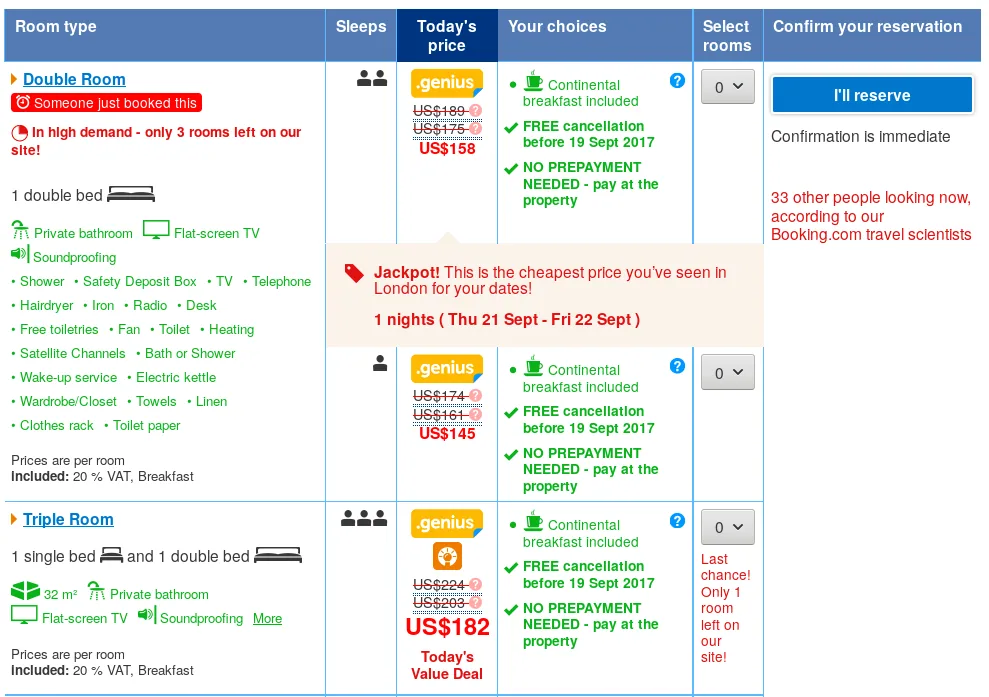 1 / 2
1 / 2
How Booking.com manipulates you.
“Many websites and applications these days are designed to trick you into doing things that their creators want… But one of the most manipulative websites I’ve ever come across is Booking.com, the large hotel search & booking service.”
1 / 2